
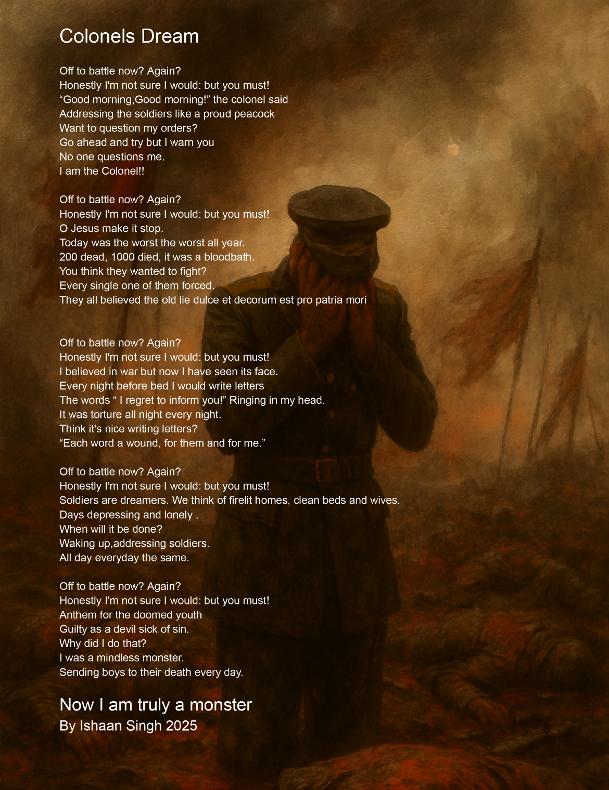
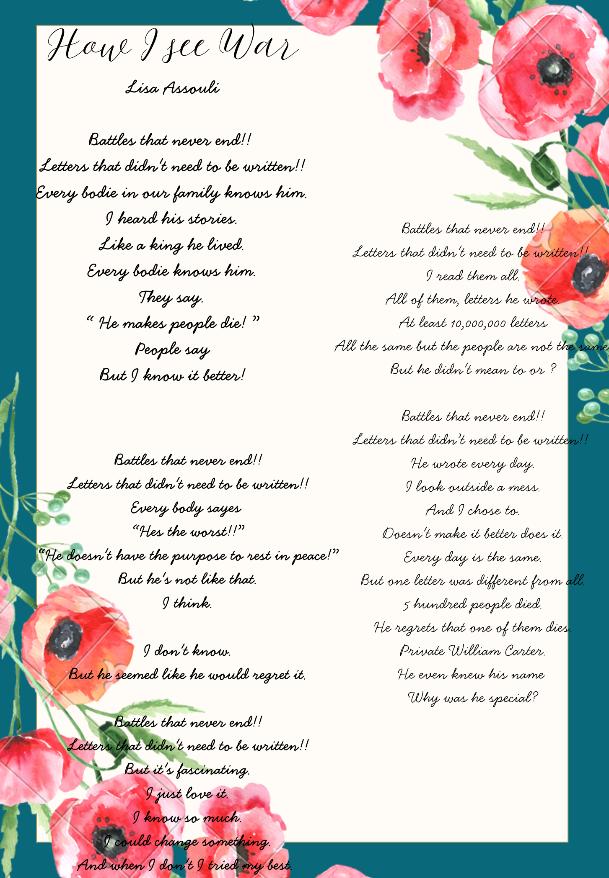
War inspired poetry by pupils from an International School in Mumbai, India
Fictional story of intertwined characters set on Ypres in 1917.
The theme
In Someone Else’s Shoes and two poems looking from the perspective of one of those characters.
Shadows of 1917
Charlotte Hayes sat at her desk, papers spread in disarray — faded photographs, torn diary pages, and letters written in an ink now the colour of rust. She rubbed her eyes. Her great-grandfather’s words, scrawled in a trembling hand, echoed in her mind:
“How does one measure the worth of an order when it means sending sons into fire?”
The library clock chimed midnight. Charlotte leaned over Billy Carter’s last letter, the one that ended with: “Keep smiling, Elsie.” She traced the familiar lines of ink with her finger. Suddenly, the room swam. The smell of dust and paper dissolved into the acrid stench of mud, smoke, and cordite.
When she opened her eyes, she was standing in Flanders, 1917.
The Trench
A young soldier crouched nearby, fumbling with his rifle. He looked up, dirt smeared across his face, but his eyes kind.
“Name’s Billy Carter,” he said, forcing a smile. “Reckon you’re lost?”
Before she could answer, a tall officer strode past, his voice sharp with command. Colonel Arthur Whitmore’s jaw was set like iron, but his eyes lingered on his men with the shadow of a man carrying far more than orders.
Billy leaned close. “He carries us all on his shoulders. Pretends he’s made of steel — but he never sleeps.”
Charlotte felt the weight of Whitmore’s silent guilt pressing on her chest.
The Field Hospital
The mud gave way beneath her feet. She stumbled into a tent where lanterns flickered against canvas walls. The air reeked of blood and iodine.
Nurse Maggie O’Donnel darted past, her apron crimson with stains, her hands steady despite exhaustion. She knelt by a boy barely older than Billy, speaking to him with the tenderness of a mother.
Then she turned to Charlotte, her Irish lilt soft but firm.
“We take them all. Ours, theirs — doesn’t matter. Every one’s a life worth saving. That’s the only way to endure this madness.”
Her hand, warm despite the chill, pressed Charlotte’s as though passing on strength across a century.
The Kitchen in Leeds
The air thickened again, and Charlotte stood in a dim kitchen lit by a single lamp. Elsie May Carter sat at the table, a black shawl across her shoulders, her hands raw from the mill. In her lap lay Billy’s last letter.
She read aloud in a trembling voice:
“Keep smiling, Elsie…”
Her lips quivered, but she raised her chin. Then she looked up and, impossibly, met Charlotte’s eyes.
“Tell them,” Elsie whispered. “Tell them we gave everything. Don’t let them forget us.”
The Sketchbook
The scene shifted to a quiet dugout, where a German soldier bent over a notebook. Friedrich Keller’s pencil moved gently, outlining a nurse’s face beside that of a little Belgian girl with a rag doll.
He noticed Charlotte and switched to careful English.
“I fight because I must. But I draw because I am still a man. One day, perhaps, they will see we were not all enemies.”
He showed her the sketch: not of war, but of life he hoped would survive it.
The Orphan
A whisper of wind carried Charlotte into the ruins of Ypres. Amid shattered stone stood a child no older than six. Claudette Martin clutched a doll in one arm and wore a greatcoat far too large for her small frame. Its buttons bore the crest of the British Army.
“It belonged to a kind man,” Claudette murmured. “A soldier named Billy gave it to me before he… before he never came back. I kept it safe.”
Charlotte’s breath caught. She knew this child would one day become the elegant model she had seen in old photographs — the coat transformed in the 1930s into a Chanel icon, its fabric woven from survival.
The Suffragette
The ruins melted into a London street. Banners waved, policemen shouted, and a crowd of women surged forward with unyielding cries.
Charlotte felt a hand grip her shoulder. Clara Rowe, fierce-eyed, was marching past.
“It is women like Elsie Carter,” Clara cried, “who give their husbands, their homes, their labour — and yet they are denied their vote. We will not be silent!”
She charged forward, swallowed by the throng, her voice echoing against the stone.
The Return
The trench, the hospital, the kitchen, the dugout, the orphan’s ruin, the marching crowd — all spun together, voices overlapping:
“Keep smiling, Elsie.”
“My boys — my burden.”
“Every life matters.”
“Remember us.”
“We must not be denied.”
Charlotte gasped — and awoke at her desk. The library clock struck one. Before her lay the same photographs, letters, and fragments of uniform, but they felt different now: no longer relics, but voices.
She picked up her pen. For the first time, she knew how to write her book. It would not be a dry account of battles and dates. It would be about love, sacrifice, courage, and the threads of humanity that stitched 1917 into memory.
She wrote the title at the top of the page, steady and certain:
“Shadows of 1917: The Story of Voices That Must Not Be Forgotten.”
RCEL - Royal Commonwealth Ex-Services League - Registered Charity No. 1174874 - Haig House, 199 Borough High Street, London SE1 1AA, United Kingdom - Telephone +44 (0)20 3207 2413
Legal Notice - Contact Us
Legal Notice - Contact Us